How to Get Better at Rhythm Games: Timing, Focus and Combos
Rhythm games train your sense of timing. Here is how to read the notes, use the beat and keep long combos alive in Rhythm Tap.
Rhythm games look like reaction tests: notes fly towards you and you press a key when they arrive. Players who improve fastest treat them as something different, a game of listening and anticipation. You are not reacting to the notes so much as moving in time with the music they follow. This guide shares practical ways to sharpen your timing in Rhythm Tap.
How Rhythm Tap works
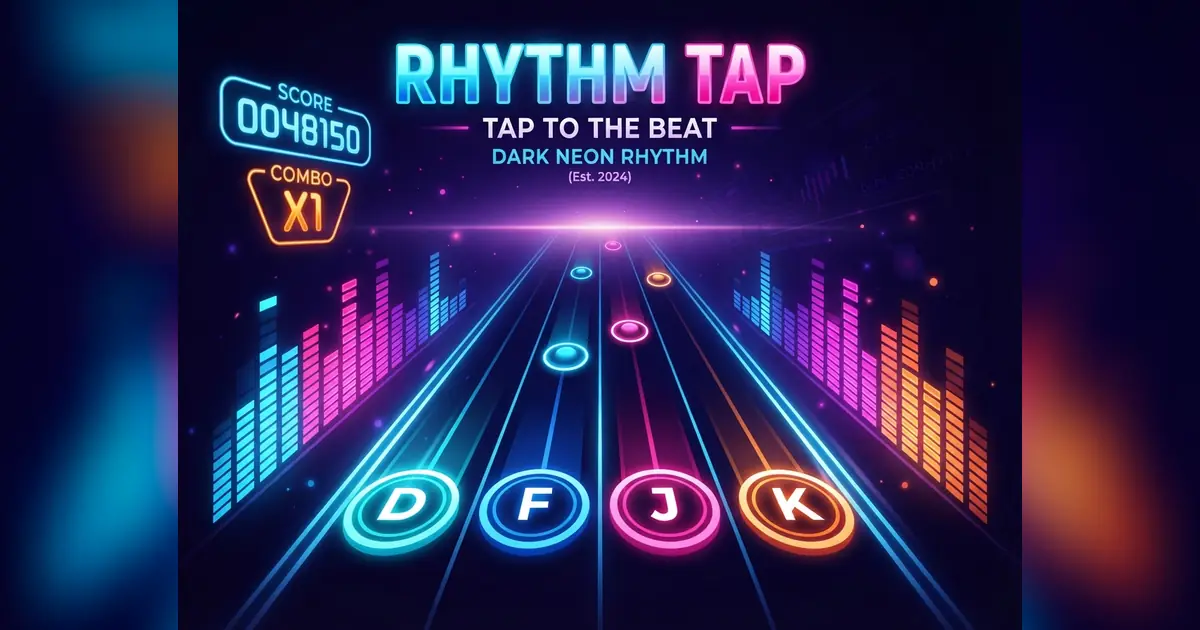
Rhythm Tap has four lanes. Glowing notes race down a neon highway in time with a soundtrack generated live in your browser, and you hit each lane as its note crosses the hit line. On a computer you can play with D, F, J and K, with the arrow keys or by clicking a lane. On a phone or tablet, tap the lane.
Perfect and good hits build your combo and score multiplier, while a miss resets the combo. There are three tracks, from a relaxed 100 BPM groove on easy to a 145 BPM sprint on hard, and every song ends with a grade from D to S based on your accuracy.
Tip 1: Listen first, watch second
The notes follow the beat of the music. Once you can feel the beat, you will know roughly when the next note is coming before it reaches the line. Try nodding your head or tapping your foot during the short count-in at the start of a song. Many players find their accuracy jumps when they stop staring at the hit line and start listening.
Tip 2: Set up your hands and keep them still
If you play on a keyboard, rest your index and middle fingers on D, F, J and K, just like typing. These keys sit on the home row, so your fingers can find them without looking. Keeping your hands in one position removes a big source of mistakes: reaching for a key and arriving late.
On a touchscreen, hold the device steady and use two thumbs, one for each pair of lanes.
Tip 3: Look a little further up the highway
Watching the hit line itself means you only see each note at the last moment. Instead, focus your eyes slightly above the line. You will see patterns earlier, such as two notes in a row on the same lane or a quick left-right alternation, and your fingers will be ready.
Tip 4: Protect the combo
Because the multiplier grows with your combo, a long unbroken streak is worth more than a handful of perfect hits followed by a miss. When the notes get dense, play safely: aim for a good hit on every note rather than a perfect hit on some and nothing on others.
If you fall behind in a fast section, do not mash every key. Mashing usually causes more misses. Let one note go, find the beat again and pick up from the next note.
Tip 5: Move up difficulty gradually
Start on the easy track until you can finish it with a high grade, then move to normal. The jump in speed from 100 to 145 BPM is large, and playing a track that is too hard teaches panic rather than timing. Returning to an easier track after a hard session is also a good way to notice how much your timing has improved.
Why timing practice matters
Rhythm games ask your brain to combine three things at once: hearing a beat, seeing a pattern and moving your fingers at exactly the right moment. Practising that coordination is a big part of why music games feel so satisfying when everything clicks. The same skill shows up in other games too: moving on a steady rhythm helps you slip through the pulsing laser grids in Laser Maze.
Quick checklist
- Feel the beat during the count-in.
- Rest your fingers on D, F, J and K.
- Look slightly above the hit line.
- Value the combo over individual perfect hits.
- Skip a note to recover instead of mashing.
Final thoughts
Good timing is a skill you build, not a talent you are born with. Listen to the music, keep your hands still and play the difficulty that suits you today. Before long, the S grade will stop feeling out of reach. Try Rhythm Tap or find more fast-paced fun in our Arcade games.